Showing posts with label SUK4. Show all posts

Friday, May 30, 2014

How instant photographs work


Instant photography is remarkable because it encompasses every individual step of photography, from the actual taking of a photograph to the developing process. The instant camera has basically a built in dark room, where traditionally the photographs are developed. The film in the instant camera is a piece of plastic paper with many layers, containing light-sensitive grains. Every layer reacts to another color. While regular film has only the layers with the light-sensitive grains, instant film contains every necessary chemical substance required for developing the photograph. First there are additional layers of developing chemicals between every light-sensitive layer. These layers are all placed on a base layer or also called black layer.  Above these light-sensitive layers is the image layer the timing layer, the acid layer and a clear plastic layer that covers up the whole picture. The arrangement of the layers is crucial for the chemical reaction to be set in motion. The reagent chemical is the essential component that causes the reaction. It  is  collected in a bulb on the side of the paper. When taking a picture, the light-sensitive layers absorb the light energy. When this happened, the film is pushed through two stainless steel rolls that break the bulb and spreads the reagent across the picture. The reagent is pressed in right between the image layer and the light-sensitive layer. This reagent contains opacifiers and alkali, which both react with the light-sensitive layer and the layers above. It starts the chemical reaction in the light-sensitive layers by changing the particles into metallic silver. Then the particles that were struck by the light, travel up into the image layer. After the film was tossed through the rolls, it comes out of the camera but the image is not visible yet. This is because the chemical reaction has not ended yet. The opacifiers in the reagent allows the film to be exposed to light because it blocks the light from reaching the other layers. The acid layer in reaction with alkali will make the opacifiers become clear. The timing layer is responsible for slowing down the reagent, to give the film enough time to develop. This is the reason why it takes some time until the image becomes visible on the film.

[374 words]

Sunday, May 25, 2014

Zombie Abstract


The purpose of this research paper is to introduce mathematical models that can be applied to any scenario imaginable. The models help to illustrate and calculate any given scenario or possible outcome.  The scope of this paper is to give a detailed equation on how to calculate all the possible results of a disease expanding very fast. In this case the example of a zombie infection is used to demonstrate the dynamic applicability of the models. By incorporating realistic factors and assumptions, the models illustrate the possible outcomes of a zombie apocalypse and also the recommended solutions to avoid the eradication of humanity.  The paper first introduces a basic model, which only works with a limited amount of possibilities. Further models are introduced in which more factors are incorporated and the mathematical possibilities become more and more realistic throughout the paper. It becomes apparent that with these mathematical equations any realistic or even unrealistic scenario can be illustrated and it can be expanded upon unlimited assumptions and factors. These mathematical models are important as they can help to model biological processes or in this case they could help us to develop a strategy for fighting off a zombie infection and prevent a zombie apocalypse from exterminating humanity .This paper reveals the fact that with mathematical analysis anything can be modeled and calculated, therefore dangerous outcomes can be avoided beforehand. 

[249 words]

Thursday, May 15, 2014

How to prevent a time-traveling assassinator from killing Hitler

Instructional text

How to prevent a time-traveling assassinator from killing Hitler

what you will need:

- a time-machine
- good negotiation skills
- a gun
- a mega-doses of methamphetamine

Step one:
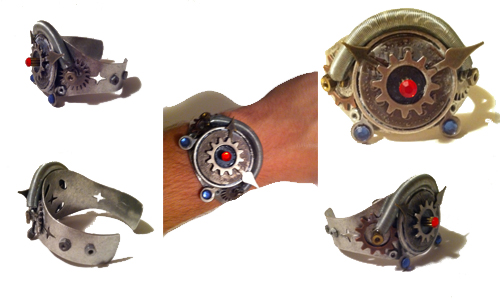
Acquire a time-machine as the one in the picture below and read the instruction manual carefully.
steampunk_time_travel_device_by_deathsdoor_inc-d48sn39.jpg
Step two:
Do some test travels to make sure you know how it works.

Step three:
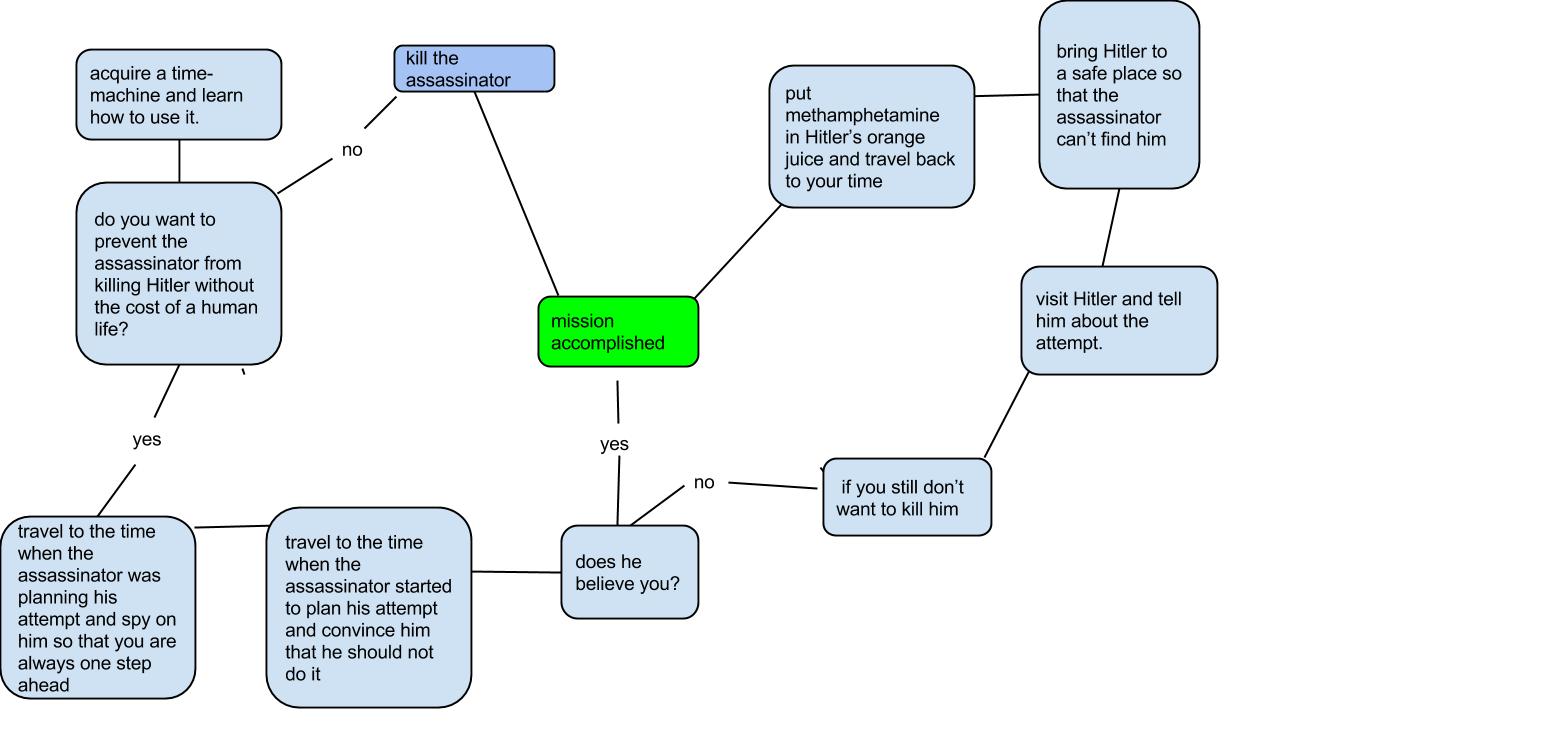
If you are willing to kill a person that wants to kill another person: buy a gun at the local gun shop and  travel to the time the assassinator was planning his attempt. If the time is right, shoot him in the head with the gun. Mission accomplished.
If you want to prevent the assassinator from killing Hitler without the cost of a human life than you need a more elaborate plan.

Step four:  
Travel to the time when the assassinator was planning his attempt against Hitler and spy on him until you know all the details of his plan.

Step five:
Make up a fake identity and try to convince the assassinator that he should not attempt to kill Hitler. Tell him that you are from the alternative future in which he succeeded in killing Hitler and that the consequences that his early death brought about are very severe.

Step six:
If the assassinator believes you than the mission is accomplished and you can travel back to your time.

If he does not believe you, then set your time machine for the date when Hitler was still alive,  three days before the planned assassination.

Step seven:
Tell Hitler everything about the planned assassination and advise him to go into hide.

In case he does not believe you, you might want to reconsider simply killing the assassinator as suggested in step two.

Step eight:
Escort Hitler to the Eagle’s Nest and make sure no one knows about it. This is necessary because later there will be no historic records about his whereabouts at that time.
EaglesNest.jpg
Step eight:
Put a mega-doses of methamphetamine in Hitler’s orange juice and travel back to your own time. Hitler will go insane because of the mega-doses of methamphetamine and he will make decisions that will later cause his fall.

[351 words]


how to prevent a time-traveling assassinator to kill Hitler.jpg

Sunday, May 11, 2014

Monday, April 21, 2014

CAJ 4: Breaking News: Kepler 186-f

On April 17th, NASA's Kepler Team announced the discovery of a planet in the habitable zone. This is a major step forward in the discovery of an Earth-like planet and a milestone for the Kepler Mission. Until recently, scientists only discovered  planets that were 40 % larger than Earth with similar properties but with the discovery of Kepler-186f, the Team can declare that there are planets similar to Earth in size and are in the habitable zone of their star, outside of our Solar system.

Kepler 186-f is claimed to be a rocky planet but scientists have to calculate the mass and density of the planet. Therefore, further analysis has to be done before drawing a conclusion. As the planet has the right size and is in the middle of the habitable zone of its star, the chance that it has liquid water is high. The temperature of the planet depends also on its atmosphere, for this reason it is not confirmed to be habitable yet.

 The planet is 500 light years away from us. The star that it orbits is half the size and dimmer than our Sun. Kepler 186f orbits its Star every 130 days. The star has  four  other planets ( Kepler186-b,c,d,e) that are all much closer to their Sun. They whiz around their Sun every 3 to 22 days, making them too hot to be habitable.


Scientists refer to Kepler186-f not as Earth-twin but as Earth-cousin. It has many properties that resemble Earth, but it gets less energy from its star than Earth gets from our Sun. On the surface of Kepler-186f the brightness of its star at high noon is only as intense as our Sun would appear for us an hour before sunset.

Only now I start to realize how important this Mission is. My CAJ topic brings, from day to day, new discoveries to light, which are in my eyes, very important historic events.


Monday, April 14, 2014

Descriptive Text - Group Work

Descriptive Text - Boy With The Toy Hand Grenade http://tiana-afterglow.blogspot.co.at/2014/04/descriptive-text-boy-with-toy-hand.html

Friday, April 4, 2014

Narrative article homework: North-Korea

Kim (12) is sitting on the shoulder of his father, curiously looking in the way everyone else is looking. The boy asks his father, ”Daddy what is going on? Why are we here?” The father’s answer is very simple and straightforward, ”I brought you here for one reason. I want you to learn that disrespecting your country will only lead to death.” The boy looks at the sunken face of his father with disappointment. Soon after a young man appears on a stage in front of the crowd. On his arms are handcuffs and he is followed by two guards. The boy can see the beaten but proud face of the young man on the stage. The son does not ask anymore, he just looks in the eyes of the young man and the young man stares back at him. After the guards announced the accusation, they simply shot the man in the head. At first Kim did not believe what happened and covered his eyes with his hands but his father took his hands and persuaded him to watch further. Nine more persons would follow and Kim had to look in the eye of all of them. While the crowd applauded, Kim’s face was sear and without any emotion. His father told him that this is a lesson he should never forget. Fortunately Kim never did and he is one of the few who could escape from the cruel and unforgiving hands of North-Korea. He is now here to tell his story.

Friday, March 28, 2014

Article Analysis: Whoa, Dude, Are We Inside a Computer Right Now?

The article "Whoa, Dude, Are We Inside a Computer Right Now?" written by Ben Makuch was published in the Vice Magazine. One could argue that the magazine isn't a scientific journal but as the interviewed person, called Rich Terrile is a well-regarded scientist who works simultaneously for the NASA and is writing a book about this subject, we can assume his credibility. Furthermore, Rich Terrile corroborates his arguments by naming respected scientists who already dealt with this hypothesis, for example Ray Kurzweil or Nick Bostom and at one point he also quotes Einstein to support his argument. As the magazine is trying to attract younger audiences, the colloquial language could be seen as intrinsic ethos. Logos is also present in the article. For example, Rick Terrile says that the universe is pixelated and that the pixels can't be broken down into smaller entities, thus the universe is logically finite. The other logical assumption we can find in the text is the reference to Moore's Law, which assumes that the computing power doubles every two years. If the universe is finite and the technical advances keep accelerating, then at some point in time the universe will be computable. Pathos is used several times in the article. Already in the introduction we can feel an appeal to the audience's sense of identity, because he writes:"It's an idea that every college student with a gravity bong and The Matrix on DVD has thought of before ". Always when he compares real life with video games he tries to affect the reading audience as they can draw an analogy to something that they might very much like. This also requires the readers to have some kind of knowledge about video games. 


Friday, March 21, 2014

CAJ 2 - Planetary Science - The Kepler Mission

My first step towards the exploration of the Universe is a NASA mission that provides us with the most recent discoveries that were considered to be science-fiction but are now scientific reality.

The Kepler Mission is one of the most important ongoing missions in planetary science. The main purpose of the Kepler Mission is to find Earth-like planets in the extrasolar system. This means, planets that orbit stars outside of our solar system. Basically this mission is supposed to find our new home. It is a real challenge to find an Earth-like planet, even in the extrasolar system. The conditions needed for living organisms are many: a solid surface, the right temperature, liquid water, an atmosphere that provides air to breath. All these conditions have to be present at once. As the chance for a planet being at exactly the right distance from it's star and being composed of the right substance and material and being Earth-sized, is very low, scientists have  to work  hard to find a planet that fulfils all of these criteria and is thus habitable.

The main device of this mission is the Kepler Telescope. The Kepler Telescope was launched in March 2009 and the initially planed lifetime was three and a half years. As the noise while progressing the data from the incoming photons of the stars was greater than expected, the mission will last longer than originally expected. If the telescope remains intact, the mission will be funded till 2016. The telescope has detected 961 extrasolar planets in more than 76 stellar systems. All of these planets vary in size, composition and mass.


The telescope operates with a photometer (device to measure light intensity). While orbiting the Sun, the photometer points to one direction in the northern constellation of Cygnus, Lyra and Draco. This is right next to the well-known Milky Way.
The squares on the picture show the field of view the telescope analyses permanently.

The photometer measures the light intensity of these stars in that field of view, and if a planet orbits the star, then the brightness of the star changes. This change in light intensity is detected by the photometer. The
phenomenon when a planet orbits the star is called transit.  The size of the planet can be calculated by the time it takes the planet to orbit the star and by the decrease in brightness that is detected by the photometer. By knowing the orbital size and the temperature of the star, the temperature of the planet can be calculated. This is crucial, as the Kepler Mission searches for habitable planets and by this calculation it knows which stars are worth further analyzing.

The telescope has a 0.95 meter diameter which is the already mentioned photometer. It has an exceptionally large view of 105 square degrees. A normal telescope has a field of view of 1 square degree (square degree is a measure similar to degree that helps measuring parts of a circle but square degree is used to measure parts of a sphere).  By providing the telescope with such a large diameter, it is capable to observe a very big field of view. The telescope is permanently looking at more than 100.000 stars and simultaneously analyzing the incoming data.

The telescope and the team working on this mission, have made many new discoveries. For example, planets orbiting two suns like in Star Wars, aren't fiction anymore but reality. Scientific reality.

Further discoveries and information about the Kepler Mission will follow.
Stay tuned.

Resources:
http://kepler.nasa.gov/
http://en.wikipedia.org/wiki/Kepler_(spacecraft)
https://www.youtube.com/watch?v=IyjbJ3Rw7Cs
https://www.youtube.com/watch?v=Q86E2abw4AY

Tuesday, March 18, 2014

PSA/ADVERTISEMENT

As this topic really awakened my interest, I decided to do a PSA and an advertisement.

PSA:

DEATH! 
What a horrible sounding word, though it is as natural as birth. Loosing someone you love is a very hard thing, but a natural one.  People have been confronted with it since ever. 
Show some respect to the person who died and don't mess with his/her fake identity.


Advertisement:


Which way do YOU choose for grieving?


 An after-death avatar helps. Alcohol doesn't.


Resources: 
http://a57.foxnews.com/global.fncstatic.com/static/managed/img/Health/660/371/Using%20Computer.JPG?ve=1&tl=1
http://www.contextview.com/wp-content/uploads/2012/06/Dependency-to-Alcohol.jpg

Friday, March 14, 2014

a day in the life of a touring hardcore-punk band

A day in the life of a touring hardcore-punk band begins usually with confusion. Sleeping every night in a different flat can cause disorientation in the first minutes of wakefullness. After having realized where they are, the band asks for a cup of coffee and depending on the environment for a hot shower. After everyone had a coffee and the hangover subsided, the band gets in the van and types in the address where it is supposed to play that evening. What follows is a long-distance drive to another city or even another country. Playing board-games or listening to music helps the band to kill boredom but after four, five days on tour, nothing seems to help. So the hours spent in the van are usually the longest. First thing the band asks for after having arrived at the destination is a short sightseeing-tour. After hours spent in the van the band really enjoys stretching their legs and having a walk in an unknown city. If they are particularly lucky they have even the opportunity to see the ocean and spend some time watching the waves clashing with the shore.
Happy and refreshed from the walk it is time to see the place where they will play in the evening. Then the band gets served excellent vegan dinner and free beer. This part of the day is the best because except breakfast they haven't eaten anything for the whole day. When enough people turned up, the promoter asks the band to get ready to play.
Excitement grows as the people gather around the stage and the band can't wait to shock the audience with their 15 minutes of angry, noisy "music". Those 15 minutes per day are the reason why the band exists and in that short time they try to give their best. After the show they enjoy the company of totally unknown people and in some cases these small-talks are the beginning of a long lasting friendship. At the end of the day the sleeping bags get rolled out and the band tries to sleep as much and as fast as possible, as the following day will again be long and eventful. 

[367 words]