Showing posts with label Part 2. Show all posts

Monday, June 16, 2014

CAJ 9: The Look into the Future of Space Telescopes/ The James Webb Space Telescope

Now we know about the two famous space telescopes that changed our notion of the Universe and helped many astronomers around the world in analyzing phenomena like the black hole, dark matter, or planets orbiting other stars. But how does the future look for space telescopes. Hubble had already five servicing missions and the Kepler Mission will also only work for maybe this decade and not longer. What will come after that? Considering that the technologies that these telescopes are using are considered to be outdated compared to the  technological advancements already existing, the question occurs what will the future space telescopes be like?

The answer to this question is The James Webb Space Telescope (JWST), or formerly known as The Next Generation Space Telescope (NGST). The Primary funding bodies are the NASA, The European Space Agency (ESA) and the Canadian Space Agency (CSA). Supposedly it will be launched in 2018 (approximately when the Kepler Mission's current mission status is over). It's Mission is to observe the Universe and study its origins and the first galaxies. From the Big Bang to the formation of solar systems and the planets in those solar systems, it will give us insight into the history of our Universe. It will be the successor of Hubble but technologically it will be much more advanced.
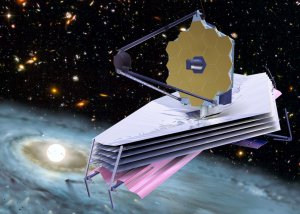


The Telescope itself will be enormous in size. Alone the sunshield will approximately be the size of a tennis court. The Mirror of the telescope will be 6.5 meters in diameter. This is nearly three times bigger than that of Hubble (2.4 m). As the size of the sunshield is bigger in width than the rocket used that launches it, the telescope, with its shield will only be unfolded when it has arrived in space.


The observatory itself consists of three main parts. The Integrated Science Instrument Module (ISIM) which is responsible for housing the cameras and the instruments. The Optical Telescope Element (OTE), which is the Eye of the Observatory. It comprises two mirrors one primary and one secondary mirror and a backplane which is the spine of the mirrors. These mirrors collect the sunlight and direct it towards the science instruments. The primary mirror consists of 18 hexagonal parts that are connected to each other and will only unfold when the observatory is in space. The Mirror itself is made of metal beryllium and is coated with gold. The second mirror, similarly like the Hubble Telescope, is reflecting the sunlight collected by the primary mirror and concentrates it towards the science instruments.  The third main part is the spacecraft bus, which is responsible for supporting functions. The six subsystems that keep the telescope functioning are located in the spacecraft bus. The Electrical Power Subsystem, the Attitude Control Subsystem, the Communication Subsystem, the Command and Data Handling Subsystem, the Propulsion Subsystem, and the Thermal Control Subsystem are all essential for the telescope to function properly.

These are only the main parts of the observatory. However, the Telescope consists of many more other elements.
The Telescope observes mainly the infrared light that comes from very distant objects, but by simply functioning, the System itself emits infrared light. For this reason the Spacecraft is also applied with a sunshield that protects it from overheating and from swamping the incoming light with infrared light emitted from the systems of the telescope. 


The already mentioned ISIM will be the heart of the telescope and includes four elements: 


Near-Infrared Camera - primary imager

Near-Infrared Spectrograph - disperses incoming light into a spectrum to analyze

Mid-Infrared Instrument - has both a camera and a spectrograph that sees light in the mid-infrared region of the electromagnetic spectrum


Fine Guidance Sensor - allows the telescope to point precisely All of these systems are the most sophisticated technologies that are currently known. This telescope will help humanity discover things that we do not even know about yet. Maybe even life on another planet. Take care, Harald
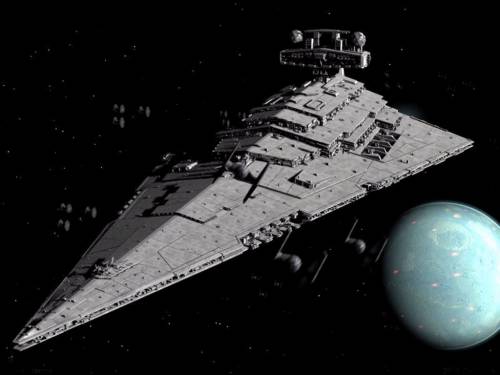
PS: Looks like Star Wars is becoming reality huh? :D


Monday, June 2, 2014

CAJ 8: The Hubble Telescope - Optics (part 3)


How is it possible that a telescope can view stars that are more hundred or even thousand light-years away? What optical device is capable of picturing galaxies that are so far away that we cannot even conceive the enormous distances?

It is not only the fact that it does not have to look through our polluted atmosphere, but also the "eyes" of Hubble. The eyes of Hubble have also a real name that is the Optical Telescope Assembly. This system is designed to offer the widest possible field of view. The system consists of two main mirrors, apertures and supporting trusses.

As the light strikes the telescope, it enters the tube, which prevents stray light to enter the telescope. After it entered the tube it passes the first optical glass. Than it strikes the first mirror that is shaped like an upside down bowl. This mirror is called the concave. Because of the shape of the mirror, it diverts the light and reflects it to the centre of the optical glass in which the second convex shaped mirror can be found. This mirror directs the light again to the first mirror. The first mirror has a hole in the Center where the light can enter and can reach its focal point right where the science instruments are placed. This basic model is called the
Ritchey-Chretien Cassegrain. 

The main mirror measures 2.4 meters in diameter. The smaller mirror that redirects the light towards the science instruments is only 0.3 meters in diameter. The focal plane where the light gets picked up is roughly the size of a dinner plate. 

The mirrors are developed in a very special way. They are treated with abrasives so that the surface of the mirrors is perfectly smooth. The mirrors are designed so that they do not deviate from a perfect curve by more than 1/800,000th of an inch. To help you understand this I use an example. The mirrors are so smooth that if the mirror were as big as the Earth in Diameter, the biggest bump would be 6 inches tall. 
The mirrors are made of ultra-low expansion glass and are kept constantly at the same temperature. This prevents the glass from cracking or warping. The surfaces are coated with a very thin layer of aluminum and a similarly thin layer of protecting magnesium-fluoride. The magnesium-fluoride allows the mirrors to be even more reflective to ultraviolet light. 

In the first post I already mentioned the first problems of the telescope with the mirrors and blurry images. This was because of the primary mirror. After the telescope was launched and the first images were sent to Earth, it became apparent that something is wrong with the telescope as the images are all very blurry. This was because the primary mirror had a flaw called spherical aberration. The outer edge of the mirror was four microns flatter than intended. Four microns equal approximately one-fiftieth of a single human hair.


During the first servicing mission this problem was solved by putting small corrective mirrors on the primary mirror. After this the images became much sharper and the telescope could start to function properly. During the fourth servicing mission the corrective mirrors were replaced by an instrument called Cosmic Origins Spectrograph. This device breaks down the light reaching the telescope. By analyzing these light waves, scientists can determine the density and chemical components of a planet. This technology was a major development and improved the telescope's sensitivity up to 10 times, especially the sensitivity to ultra-violet light. 

Sunday, May 25, 2014

Zombie Abstract


The purpose of this research paper is to introduce mathematical models that can be applied to any scenario imaginable. The models help to illustrate and calculate any given scenario or possible outcome.  The scope of this paper is to give a detailed equation on how to calculate all the possible results of a disease expanding very fast. In this case the example of a zombie infection is used to demonstrate the dynamic applicability of the models. By incorporating realistic factors and assumptions, the models illustrate the possible outcomes of a zombie apocalypse and also the recommended solutions to avoid the eradication of humanity.  The paper first introduces a basic model, which only works with a limited amount of possibilities. Further models are introduced in which more factors are incorporated and the mathematical possibilities become more and more realistic throughout the paper. It becomes apparent that with these mathematical equations any realistic or even unrealistic scenario can be illustrated and it can be expanded upon unlimited assumptions and factors. These mathematical models are important as they can help to model biological processes or in this case they could help us to develop a strategy for fighting off a zombie infection and prevent a zombie apocalypse from exterminating humanity .This paper reveals the fact that with mathematical analysis anything can be modeled and calculated, therefore dangerous outcomes can be avoided beforehand. 

[249 words]

Monday, April 28, 2014

CAJ 5: The Flower-shaped Star Shade.

The Kepler Mission is very important in detecting earth-like planets but it is not capable of studying the features of the planet in more detail. As the light of the star is too intense to analyze the orbiting planet. It’s  challenging to observe a planet orbiting another star, because the bigger the distance the paler and dimmer the image. The star is too bright and the planet too close to the star. Even though the atmosphere that would smear the light is not a problem in space (as there is no atmosphere) the light scatter and the diffraction in the telescope are still problems that need to be addressed.


There are many suggestions to resolve this problems but the most obvious and promising one is the flower-shaped star shade. This is an occulting device that blocks the starlight and thus it can not even enter the optical path.One of the major advantages of the star shade is that this construction is feasible with existing technology.  This device helps the telescope to achieve a much more detailed image of the terrestrial bodies around the star. In order to minimize the diffracted light, the distance between the telescope and the star shade must be around 40.000 kilometers. The star shade must be approximately 50 meters in diameter and the optic of the telescope diffraction limited and at least 1 meter in diameter to achieve the deepest shadow.


The star shade and the telescope would be one spacecraft and only in space they would separate and move away from each other. In order to receive the best results possible , the star shade is equipped with small thrusters that help to remain in position while observing the bodies around the star in more detail. The form of the star shade is important. Without the “leafs” around it, the light waves would still be too strong to achieve a detailed image of the planets around it. Scientists worked on this star shade tirelessly, for a long time. After numerous mathematical calculations and several prototypes, they suggested this shape, as it helps to control the fraction of the light.


This invention will help us to discover and analyze planets for liquid water and oxygen. It will help the telescopes to photograph major features of the chosen planets, like oceans or mountains. Another important advantage of this invention is that it is within the budgetary scope of NASA and it is within the reach of existing technology.


http://newworlds.colorado.edu/info/documents/CashNatureJuly2006.pdf


http://www.ted.com/talks/jeremy_kasdin_the_flower_shaped_starshade_that_might_help_us_detect_earth_like_planets?utm_source=facebook.com&utm_content=awesm-bookmarklet&awesm=on.ted.com_c08UP&utm_medium=on.ted.com-facebook-share&utm_campaign=#

Friday, April 4, 2014

CAJ 3: Still searching for our new home/ planet categories / Kepler 16-b

Now that I have introduced briefly the Kepler Mission, I want to talk a little bit more about the planet candidates and discoveries that the mission has brought to light.

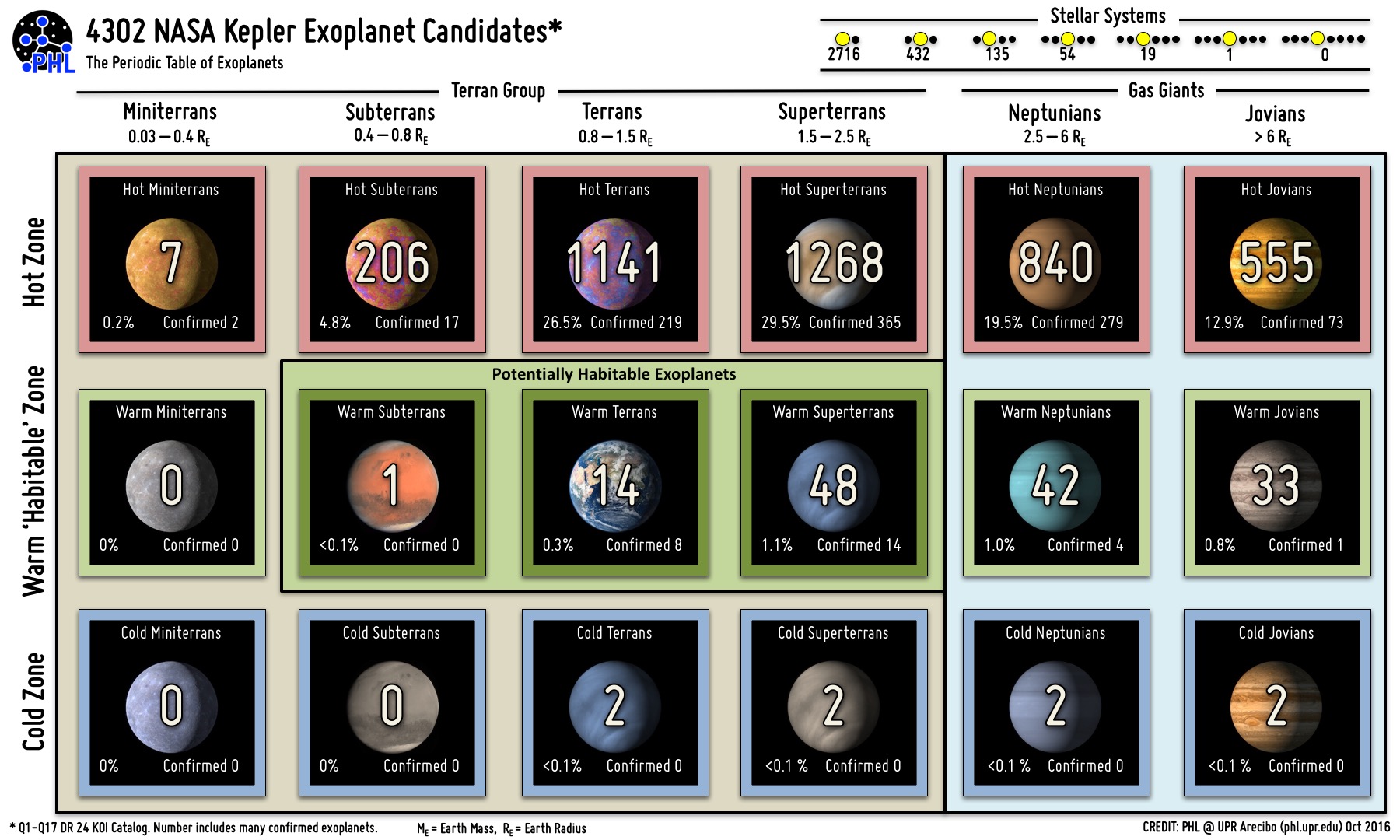
To categorize the planets, scientist have created a "Periodic Table of Exoplanets". This system  helps the scientists to classify the newly discovered planets into six main categories. They differentiate planets
by mass/size and three temperature subgroups. This makes 18 categories in total. The three temperature groups are cold zone, warm zone (habitable zone) and hot zone. According to mass and size there are 6 groups, which are mercurian, subterran, terran, superterran( these four constitute the terrestrial planets), neptunians and jovians (these are called the gas giants). Mercurian planets are approximately the size of our Moon or Mercury and they are atmosphere-less low mass planets. Subterran planets are comparable to Mars, terrans are planets like the Earth, superterran is the only group for which our solar-system has no example. Neptunian, as the name already tells, is the category in which the planets are as big as Neptune, and jovian planets are in our solar-system Jupiter or Saturn or even bigger.


On this picture you can see the confirmed exoplanets that are known by the NASA. The number in the
middle of each picture shows how many of these planets have been discovered so far. In the upper right corner you can also see the multiple number of stellar systems.


These are only the confirmed planets. The Kepler Mission has discovered many more planets, which aren't yet confirmed to be one. In order to confirm that a planet candidate is a planet it must regularly orbit a star with the same transit time. For earth like planets in the habitable zone this means that it has to transit a star for three years to make sure it is one.

 This picture shows how many planet candidates the Kepler Mission helped to discover. As you may see, there are many warm superterran planets outside of our solar system, which are particularly interesting for the scientists. They haven't had the chance to take probes or analyze them closer and as there are no superterran planets in our solar system, the scientists are very curious about their features.

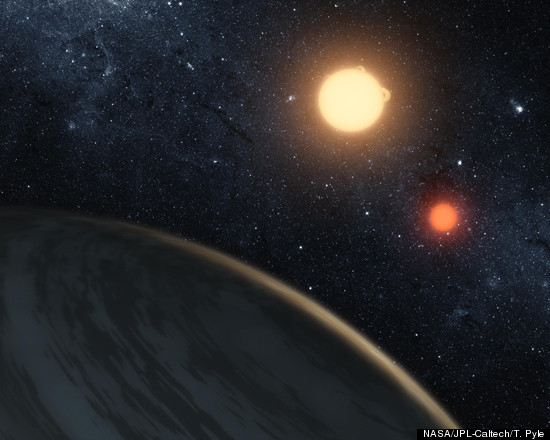
In September 2011 the Kepler Mission announced a discovery which was for many science-fiction fans a day to remember. The Kepler Telescope discovered a planet that orbits two suns. This planet is 200 light-years away from Earth. The solar system is called the Kepler 16 and the name of the planet is Kepler 16-b. The planet is outside of the habitable zone and is said to be a cold world without liquid water. It orbits both stars every 226 days. The discovery was made when the Kepler Scientists discovered a second object transiting the main star that turned out to be a second star. It has a smaller orbit and that means that it orbits the main star faster than Kepler 16-b.The stars are both smaller than our sun. The fact that a phenomenon like this exists shows how mysterious and diverse our Universe is. The reason why most science-fiction fans are interested in this is because Star Wars worked with a similar concept, without knowing about the existence of the phenomenon.

Friday, March 28, 2014

Article Analysis: Whoa, Dude, Are We Inside a Computer Right Now?

The article "Whoa, Dude, Are We Inside a Computer Right Now?" written by Ben Makuch was published in the Vice Magazine. One could argue that the magazine isn't a scientific journal but as the interviewed person, called Rich Terrile is a well-regarded scientist who works simultaneously for the NASA and is writing a book about this subject, we can assume his credibility. Furthermore, Rich Terrile corroborates his arguments by naming respected scientists who already dealt with this hypothesis, for example Ray Kurzweil or Nick Bostom and at one point he also quotes Einstein to support his argument. As the magazine is trying to attract younger audiences, the colloquial language could be seen as intrinsic ethos. Logos is also present in the article. For example, Rick Terrile says that the universe is pixelated and that the pixels can't be broken down into smaller entities, thus the universe is logically finite. The other logical assumption we can find in the text is the reference to Moore's Law, which assumes that the computing power doubles every two years. If the universe is finite and the technical advances keep accelerating, then at some point in time the universe will be computable. Pathos is used several times in the article. Already in the introduction we can feel an appeal to the audience's sense of identity, because he writes:"It's an idea that every college student with a gravity bong and The Matrix on DVD has thought of before ". Always when he compares real life with video games he tries to affect the reading audience as they can draw an analogy to something that they might very much like. This also requires the readers to have some kind of knowledge about video games. 


Monday, March 17, 2014

CAJ 1 - Planetary Science - Introduction

My CAJ topic is "planetary science", which is the study of planets, solar systems, moons and terrestrial bodies in the Universe. The focus of my research will mainly include the space telescopes and their mission to find a habitable, earth-like planet in space. I will introduce the Kepler Mission in depth and the major achievements and discoveries that are attributed to it. I will also introduce the Hubble Telescope and its importance for planetary science. Furthermore, the research will focus on the recent projects and developments that are supposed to help in achieving better results in analyzing and finding planets. The future prospect of planetary science will also be discussed. My goal is to expose the importance of this topic for the future of humanity and to prove how interesting planetary science is.