Showing posts with label keplermission. Show all posts

Friday, April 4, 2014

CAJ 3: Still searching for our new home/ planet categories / Kepler 16-b

Now that I have introduced briefly the Kepler Mission, I want to talk a little bit more about the planet candidates and discoveries that the mission has brought to light.

To categorize the planets, scientist have created a "Periodic Table of Exoplanets". This system  helps the scientists to classify the newly discovered planets into six main categories. They differentiate planets
by mass/size and three temperature subgroups. This makes 18 categories in total. The three temperature groups are cold zone, warm zone (habitable zone) and hot zone. According to mass and size there are 6 groups, which are mercurian, subterran, terran, superterran( these four constitute the terrestrial planets), neptunians and jovians (these are called the gas giants). Mercurian planets are approximately the size of our Moon or Mercury and they are atmosphere-less low mass planets. Subterran planets are comparable to Mars, terrans are planets like the Earth, superterran is the only group for which our solar-system has no example. Neptunian, as the name already tells, is the category in which the planets are as big as Neptune, and jovian planets are in our solar-system Jupiter or Saturn or even bigger.


On this picture you can see the confirmed exoplanets that are known by the NASA. The number in the
middle of each picture shows how many of these planets have been discovered so far. In the upper right corner you can also see the multiple number of stellar systems.


These are only the confirmed planets. The Kepler Mission has discovered many more planets, which aren't yet confirmed to be one. In order to confirm that a planet candidate is a planet it must regularly orbit a star with the same transit time. For earth like planets in the habitable zone this means that it has to transit a star for three years to make sure it is one.
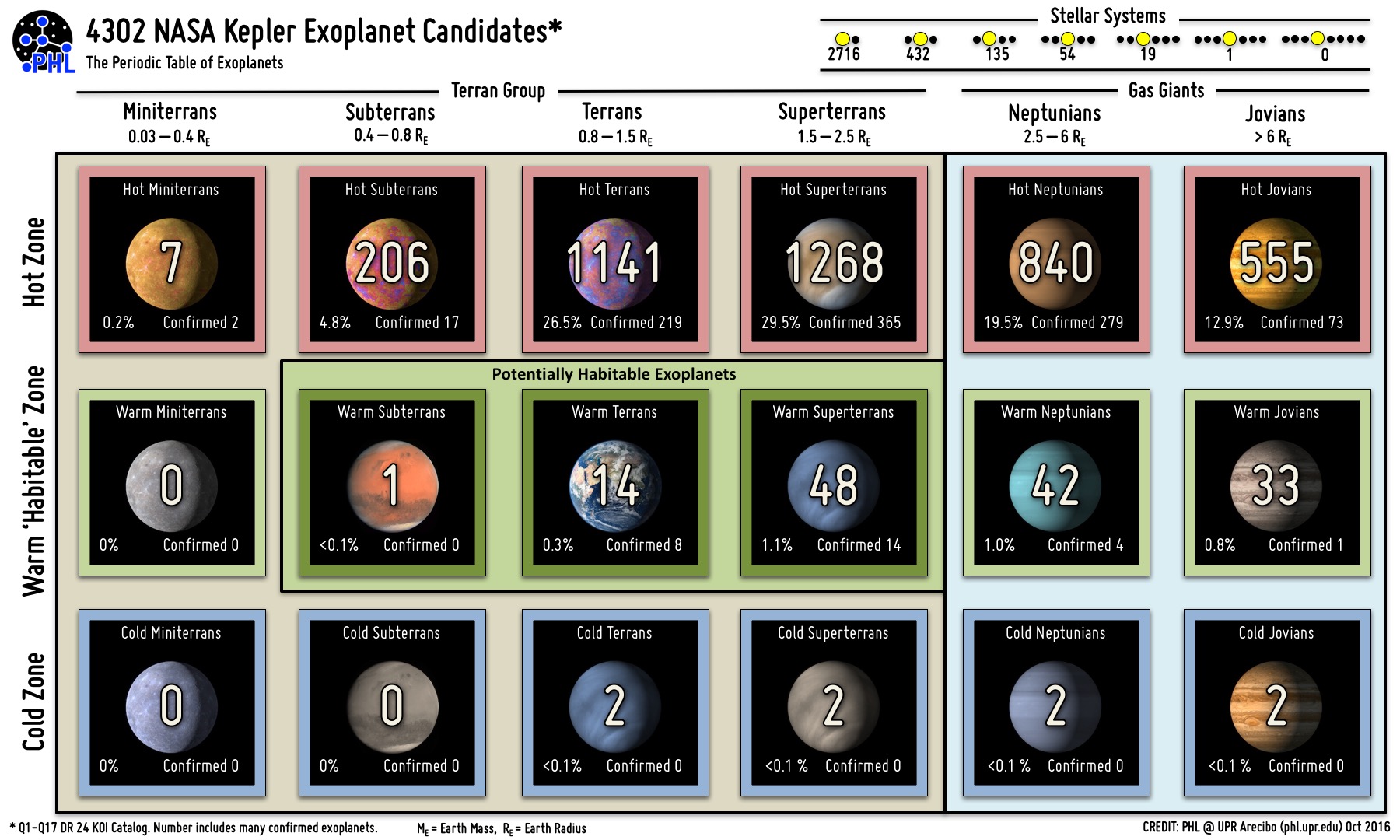
 This picture shows how many planet candidates the Kepler Mission helped to discover. As you may see, there are many warm superterran planets outside of our solar system, which are particularly interesting for the scientists. They haven't had the chance to take probes or analyze them closer and as there are no superterran planets in our solar system, the scientists are very curious about their features.

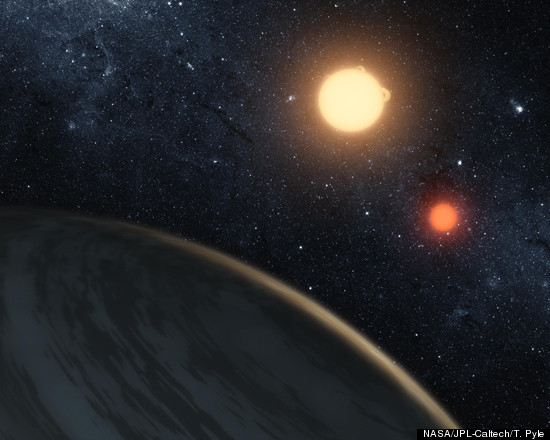
In September 2011 the Kepler Mission announced a discovery which was for many science-fiction fans a day to remember. The Kepler Telescope discovered a planet that orbits two suns. This planet is 200 light-years away from Earth. The solar system is called the Kepler 16 and the name of the planet is Kepler 16-b. The planet is outside of the habitable zone and is said to be a cold world without liquid water. It orbits both stars every 226 days. The discovery was made when the Kepler Scientists discovered a second object transiting the main star that turned out to be a second star. It has a smaller orbit and that means that it orbits the main star faster than Kepler 16-b.The stars are both smaller than our sun. The fact that a phenomenon like this exists shows how mysterious and diverse our Universe is. The reason why most science-fiction fans are interested in this is because Star Wars worked with a similar concept, without knowing about the existence of the phenomenon.
Friday, March 21, 2014

CAJ 2 - Planetary Science - The Kepler Mission

My first step towards the exploration of the Universe is a NASA mission that provides us with the most recent discoveries that were considered to be science-fiction but are now scientific reality.

The Kepler Mission is one of the most important ongoing missions in planetary science. The main purpose of the Kepler Mission is to find Earth-like planets in the extrasolar system. This means, planets that orbit stars outside of our solar system. Basically this mission is supposed to find our new home. It is a real challenge to find an Earth-like planet, even in the extrasolar system. The conditions needed for living organisms are many: a solid surface, the right temperature, liquid water, an atmosphere that provides air to breath. All these conditions have to be present at once. As the chance for a planet being at exactly the right distance from it's star and being composed of the right substance and material and being Earth-sized, is very low, scientists have  to work  hard to find a planet that fulfils all of these criteria and is thus habitable.

The main device of this mission is the Kepler Telescope. The Kepler Telescope was launched in March 2009 and the initially planed lifetime was three and a half years. As the noise while progressing the data from the incoming photons of the stars was greater than expected, the mission will last longer than originally expected. If the telescope remains intact, the mission will be funded till 2016. The telescope has detected 961 extrasolar planets in more than 76 stellar systems. All of these planets vary in size, composition and mass.


The telescope operates with a photometer (device to measure light intensity). While orbiting the Sun, the photometer points to one direction in the northern constellation of Cygnus, Lyra and Draco. This is right next to the well-known Milky Way.
The squares on the picture show the field of view the telescope analyses permanently.

The photometer measures the light intensity of these stars in that field of view, and if a planet orbits the star, then the brightness of the star changes. This change in light intensity is detected by the photometer. The
phenomenon when a planet orbits the star is called transit.  The size of the planet can be calculated by the time it takes the planet to orbit the star and by the decrease in brightness that is detected by the photometer. By knowing the orbital size and the temperature of the star, the temperature of the planet can be calculated. This is crucial, as the Kepler Mission searches for habitable planets and by this calculation it knows which stars are worth further analyzing.

The telescope has a 0.95 meter diameter which is the already mentioned photometer. It has an exceptionally large view of 105 square degrees. A normal telescope has a field of view of 1 square degree (square degree is a measure similar to degree that helps measuring parts of a circle but square degree is used to measure parts of a sphere).  By providing the telescope with such a large diameter, it is capable to observe a very big field of view. The telescope is permanently looking at more than 100.000 stars and simultaneously analyzing the incoming data.

The telescope and the team working on this mission, have made many new discoveries. For example, planets orbiting two suns like in Star Wars, aren't fiction anymore but reality. Scientific reality.

Further discoveries and information about the Kepler Mission will follow.
Stay tuned.

Resources:
http://kepler.nasa.gov/
http://en.wikipedia.org/wiki/Kepler_(spacecraft)
https://www.youtube.com/watch?v=IyjbJ3Rw7Cs
https://www.youtube.com/watch?v=Q86E2abw4AY