If a noun or expression is followed by the word "experience" it always reminds me of Jimi Henrdix.:)
When I first heard about this Pecha Kucha thing I wasn't sure what to think about it. I thought that its going to be a lot of work and effort crammed in 6 minutes and 40 seconds. I was totally right but I haven't thought of the fact that I could actually enjoy the work.
My assigned partner was Orsolya and I was happy that I could finally prepare something with a partner I know well. I know that the purpose of teamwork is that you have the chance to work with someone you don't know and to collect new experience, but still, knowing that I will work with Orsolya was a great relief. She is a very positive person who loves to do things passionately and that makes the work much easier. The other thing that made the PK a positive experience was the topic. I know we may seem obsessed with Hungary, but trust me, we aren't. We just wanted to work on something that we know well in order to create something that is important for both of us. I mean, who could give you a better insight into the reasons why Hungarians come to Austria than two Hungarians who came to Austria. :D
The Process:
We started off by making a rough outline of what we want to speak about and what we should include. We knew that a short history section in the beginning would make out a good start and that it would create a good base for the whole project. Than we had a lot of other things to do so we just laid the project by side. In the middle of November we started preparing it. We met like five, six times for three, four hours. We progressed from slide to slide. Sometimes it was obvious what we want to say but then there were slides which we had to think about much more. Luckily, Orsolya had all her history books from High School that were even written in English.
From the beginning on we always measured time to know how much we can say to one picture. That helped us with remembering the transcript and it also gave us a good feeling for the pace. The hardest part of the presentation was searching for good pictures. We had slides which took us one or two hours till we found a picture that both of us liked.
Four-five days before the presentation day we met more frequently and practiced the whole thing just a couple of times every day and individually at home. I would listen to the recording and walk around in my room, doing as if I would present it to the class. As it was only 7 minutes long I could practice it a lot and soon I knew it by heart.
The Product:
I would lie if I said I wasn't excited but I got used to speaking and presenting in front of a bigger audience, so I for me it was pretty relaxed. The other thing is that I like the group so its not like presenting to unknown people. Most of them I already knew last year and even if we don't spend too much time together, the fact that everyone is walking in the same shoes made the whole thing a collective experience.
As we practiced our presentation a lot, I think it went as expected. The timing was right and I hope the pronunciation too. Language and content-wise our presentation was maybe a bit too simple, compared to other ones. We just didn't want to include difficult expressions that would only confuse the audience. We followed the suggestion: "Keep it short and simple".
I don't know why but I just couldn't wash the smile of my face while presenting. I really enjoyed it.
It was nice to watch the other presentations and I really enjoyed them all. I think everyone did a great job. The only negative thing that I can mention is that 5 presentations within 1 hour were simply too much. I can hardly remember any information that was said during the presentations.I concentrated more on the language and the presenting styles of my classmates and because of that the content often just went in on one ear and out on the other.
All in all, I really enjoyed the whole atmosphere and I left school for Christmas break with a really good feeling.
Take care,
Harald
Showing posts with label WS13. Show all posts
Showing posts with label WS13. Show all posts
Sunday, January 12, 2014

Saturday, January 11, 2014
My system for improving my vocabulary
I'm a bit late with this post but better late than never. As we run out of time it is better to get it out of the way now, as I assume that I won't have time for it later.
I don't have to say how important it is to collect and improve vocabulary in the process of learning a language. It helps to express yourself better and colors the language. Isn't it a beautiful feeling when you use a word in a conversation for the first time without having to think about it for 2 minutes?
Here is my system for improving my vocabulary:
The most convenient way of studying vocabulary is vocabulary.com. It adapts to your level and helps you to study words systematically. Normally I do 3 tests per day but since we have to improve our pronunciation I rather do spelling bee as it helps me with the pronunciation and on the right hand side it provides short definition of the word. Here is a picture of my process so far:

As those short definition aren't always enough to really understand a word, I search for a better definition in longman dictionary online and look how the word is used and what forms it can occur. In order to remember the word I write it down in my notebook. I've heard that writing down a word helps remembering it because the word gets processed by your brain while you write it down. Here is a picture of my notebook:

Although writing it down helps you to remember the word better, revising the words and creating example sentences is still very important. So I make sure to revise them regularly, especially before an exam.
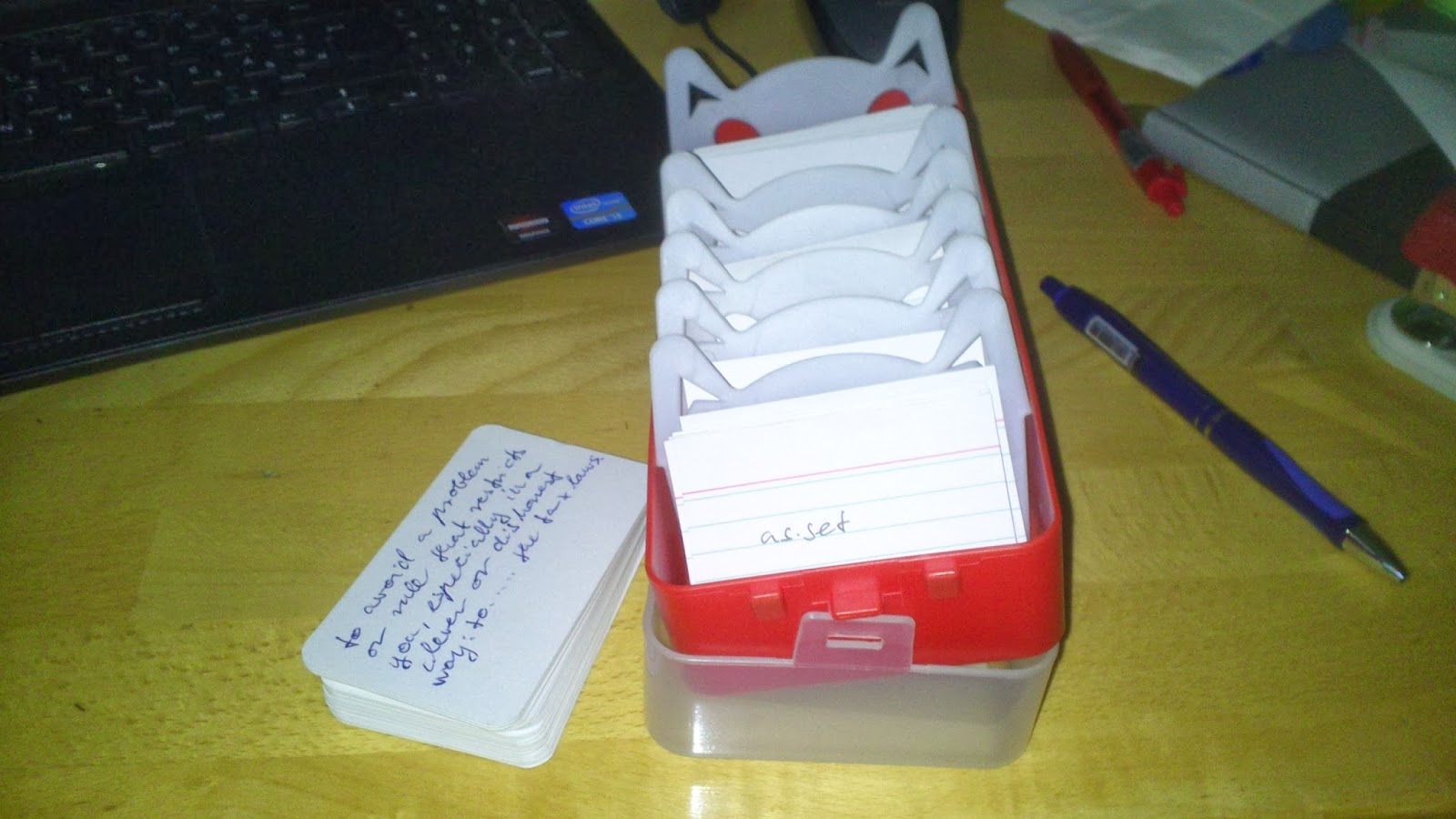
I also love flashcards, though I didn't use them too much throughout the semester. Originally I use it for words which I stumble over accidentally and are worth remembering, but at the beginning of the semester I decided to use them to write down words and definition related to finance and economics. I thought it's going to help me with Henry's class. In the beginning it did but unfortunately the semester was too demanding and I simply didn't find the time to do it regularly. I know...silly excuse :D.
Take care,
Harald
Wednesday, December 18, 2013
Pronunciation Diary 2
Dear all,
Winter break is getting closer and closer but somehow as it gets closer the more I long for it. So the last days are getting longer and longer. At least I finished every homework I wanted before the break so know I can really lay back and relax at least for a couple of days. However, let's speak about pronunciation.
After writing the last post I started to think about what my problems are with English pronunciation. The one I've chosen for this post is the "th" sound.
Our teachers in High School tried their best to explain how to form this sound, but as they couldn't form the sound neither it was kinda a fool's errand.
My problem was that instead of saying "th" I frequently pronounced it as a simple "t". I feel particularly uncomfortable saying the word "worth". That "th" sound after the "r" is very difficult to pronounce.
After listening like 30 times to the program on vocabulary.com pronouncing the word "worth" it gets better but I still have to work on it. Sometimes I forget to put my tongue to the edge of my teeth and because of that it simply sound like an "s".
Here is a recording of me where I read a short poem with a couple of "th" sounds for the first time:
https://soundcloud.com/herold-flux/th
Here I tried it for a second time. A bit better if you ask me.
https://soundcloud.com/herold-flux/th-2
Take care,
Harald
Winter break is getting closer and closer but somehow as it gets closer the more I long for it. So the last days are getting longer and longer. At least I finished every homework I wanted before the break so know I can really lay back and relax at least for a couple of days. However, let's speak about pronunciation.
After writing the last post I started to think about what my problems are with English pronunciation. The one I've chosen for this post is the "th" sound.
Our teachers in High School tried their best to explain how to form this sound, but as they couldn't form the sound neither it was kinda a fool's errand.
My problem was that instead of saying "th" I frequently pronounced it as a simple "t". I feel particularly uncomfortable saying the word "worth". That "th" sound after the "r" is very difficult to pronounce.
After listening like 30 times to the program on vocabulary.com pronouncing the word "worth" it gets better but I still have to work on it. Sometimes I forget to put my tongue to the edge of my teeth and because of that it simply sound like an "s".
Here is a recording of me where I read a short poem with a couple of "th" sounds for the first time:
https://soundcloud.com/herold-flux/th
Here I tried it for a second time. A bit better if you ask me.
https://soundcloud.com/herold-flux/th-2
Take care,
Harald
Tuesday, December 17, 2013
Why the European Union schould intervene to stop Hungary from a dictatorship
First draft:
The purpose of the European Union is to establish and maintain a strong connection between its member states and to develop their economy. The EU balances and governs many countries that all have a different political direction and economic condition and also provides guidelines and regulations that have to be implemented by the member states in order to enjoy the benefits of being a part of the Union. For example, the EU lends money to its member states at a low interest rate so they can enhance their economy.The problem arises when not all of the member states are eager to participate. The black sheep of the Union is in this case Hungary. Since 2010, Hungary suffers from the consequences of a very bad decision, namely electing the political party FIDESZ with a two third majority. Due to this, Hungarian people empowered one party that is allowed to make decisions and implement laws without having to deal with and actual opposition party. The president of the FIDESZ and therefore Prime Minister of Hungary is Viktor Orbán. He is the person who holds every string in his hands and leads the country into an economic catastrophe. He, being the most influential person in Hungary, misused his power and caused the country to slide into bankruptcy. Apart from the creating the economic catastrophe, he is known for his strict policies against Roma, Jews and other minorities.
Shortly after the election of FIDESZ, the party immediately abandoned Hungary’s constitution and wrote an entirely new one within two weeks. With the new constitution the party reinforced their position and created a strong base for their rulership. The new constitution inhibits the political independence of the central bank. Apart from this, the new institution has caused many other negative economic changes, like the imposition of a new bank tax, which mainly affects foreign companies which have their seats in Hungary. This new tax helped on the one hand to improve the revenue but on the other hand it caused that many firms had to dismiss their employees or were even forced to shut down. In consequence, the unemployment rate has risen even more.
Orbán is also criticized for his unsuccessful discussions with the International Monetary Fund (IMF). After being neglected the requested borrowing conditions due to his controversial behaviour and critical statements, the situation deteriorated. Orbán went so far as to borrow money with a 9% interest rate instead of working together with the IMF who usually offers a loan for a 3% interest rate. His reason for borrowing money for such a high interest rate is that he does not want to depend on EU funding.These actions all contribute to the inflation and downturn of the Hungarian economy. The result of Orban’s strategy is that investors fear investing in the Hungarian market due to its unpredictable economic future.
Feedback summary
The other group provided us with very useful and corrective suggestions that we. They discovered that our topic sentences often only introduce one part of the paragraph so that much information is missing that could be relevant for the reader. The other problem they discovered was that our first paragraph needed a clear thesis and a topic. We partly resolved the problem. As the title clearly introduces the topic we did not feel the need to write it explicitly in the first paragraph. Concerning our thesis, we tried to write the text according to our opinion and we think the way it is written clearly reflects our opinion. In the second paragraph the concluding sentence did not conclude the paragraph. Without their constructive feedback our text would lack cohesion and it would not be what we want it to be.
Revised version:
Although the main goal of the European
Union is to maintain and consolidate democracy among its member states, over the past three years, events occuring
in Hungary have demonstated a developing shift of Hungarian government form
from democracy to dictatorship, induced by FIDESZ, a national-conservative
party. With winning over a two third majority in 2010’s governmental elections,
Hungarian people empowered one sole party. Since then, FIDESZ can make all the
crucial decisions and implement laws without having to deal with an actual
opposition party. The president of FIDESZ and therefore Prime Minister of
Hungary is Viktor Orbán. He, being the most powerful person of Hungary, has
been abusing his power and caused the country to slide into bankruptcy However,
the EU has done almost nothing to prevent Hungary, which is an EU member since
2004, from sliding into dictatorship.
Shortly after the election
of FIDESZ, the party abandoned Hungary’s previous constitution and wrote an
entirely new one within two weeks, causing damage to the country’s economy and
democracy. With the new constitution the party reinforced their position and
created a strong base for their rulership. The constitution inhibits the
political power of opposition parties and the independence of the MNB, the
Hungarian National Bank. The new law on the MNB was adopted without
taking into account all the observations of the European Central Bank. In
addition, the MNB’s rate-setting panel, the Monetary Council, is made up
entirely of members chosen by the ruling FIDESZ party.
Apart from this, the new institution has
caused many other negative economic changes, like the imposition of a new bank
tax, which mainly affects foreign companies which have their seats in Hungary.
This new tax helped on the one hand to raise the governmental revenue but on
the other hand it caused that many firms had to dismiss their employees or were
even forced to shut down. In consequence, the unemployment rate has reached
more than 10 % and many blame Orbán for this.
Orbán is also criticized for his
unsuccessful discussions with the International Monetary Fund (IMF). After
being neglected the requested borrowing conditions due to his controversial
behaviour and critical statements, the situation deteriorated. Orbán went so
far as to borrow money with a 9% interest rate instead of working
together(cooperating) with the IMF who(that) usually offers a loan for a 3%
interest rate. His reason for borrowing money for such a high interest rate is
that he does not want to depend on EU funding. These actions all contribute to
the inflation and downturn of the Hungarian economy. The result of Orban’s strategy
is that investors fear investing in the Hungarian market due to its
unpredictable economic future.
The most controversial issue that awakened
the EU’s attention was the changes regarding Hungary’s media law. The media law
forces TV channels, radio stations and newspapers to only publish news that
have been approved by the party. By this, many aspects of democracy are hurt
since no other opinions concerning politics are tolerated at the main
broadcasting channels. Opposition parties have therefore almost no opportunity
to present themselves in the media or to attract voters. In addition to this,
FIDESZ and its various subsidiary organisations have the power to decide which
journalists are being employed. If a journalist does not comply with the party’s
ideology or expresses criticism, he or she will be dismissed immediately and
will be very unlikely to find a new job in the media industry.
Hungary’s future would
affect not only Hungary on its own but the whole EU. Therefore, the EU needs to
intervene as it is responsible for maintaining economic stability and democracy
in Europe. For doing so, the EU has certain tools. As Hungary has signed the
membership agreement, they have to follow the provided guidelines. However, in
case a member country fails to come up to the requirements, the EU has the
right to suspend their voting rights in the EU commision. If this happened,
Hungary would not be able to cast its vote when deciding about the EU budget or
putting forward legislative proposal to the EU parliament. Suspending Hungary
from its voting rights would be a severe punishment, but if the Hungarian
government did not react to it and continued violating fundamental democratic
rights, the EU could apply penalties with which Hungary would be excluded from
the European market. If this happened, Hungary would have no other chance but
obey the EU. Although this would be an extremely radical measurement, which has
never been implemented in the history of the EU, it is the only hope for
Hungary. Only the international pressure will help Hungary, because
domestically the country is already lost. The EU needs to come up to its
original purpose of maintaining democracy and freedom in order to prevent
Europe from a new era of dictatorship, even if it is only in a small country
like Hungary.
[815 words]
Teresa Brenner
Sonja Haunschmid
Artur Schefer
Harald Pasch
Corrected version:
Hungary’s future not only affects Hungary on its own but the whole EU, as the Union’s well-being depends on every member country. As it is responsible for maintaining economic stability and democracy in Europe, the EU needs to intervene. For doing so, the EU has certain methods. As Hungary has signed the membership agreement, they have to follow the guidelines. If a member country fails to meet the requirements, the EU has the right to suspend their voting rights in the EU commission. If this happened, Hungary would not be able to cast its vote when the EU is deciding about the budget and it could not put forward a legislative proposal to the EU parliament. Suspending Hungary’s voting rights would be a severe punishment, but if the Hungarian government did not react to this and continued violating fundamental democratic rights, the EU could apply penalties which would exclude Hungary from the European market. If this happened, Hungary would have no other choice but to adhere to the EU. Although this would be an extremely radical measure, which has never been implemented in the history of the EU, it would save the Hungarian democracy. Only the international pressure will help Hungary, because domestically the country is already lost. The EU needs to remind itself of its original purpose of maintaining democracy and freedom in order to prevent Europe from a new era of dictatorship, even if it is only in a small country like Hungary.
The main goal of the European Union is to maintain and consolidate democracy among its member states. Nevertheless, events occurring in Hungary over the past three years have demonstrated a developing shift in Hungarian government form from democracy to dictatorship, induced by FIDESZ, a national-conservative party. During the governmental
elections of 2010, it managed to defeat other parties by winning a two thirds
majority. Thereupon, FIDESZ can make all the crucial decisions and implement
laws without having to deal with an opposition party. The president of FIDESZ
and therefore Prime Minister of Hungary is Viktor Orbán. As the most powerful
person in Hungary, he has been abusing his power and has caused the country to
slide into bankruptcy. Despite all the controversial adjustments implemented in
Hungary, the EU has done almost nothing to prevent its government form slowly turning
into dictatorship.
elections of 2010, it managed to defeat other parties by winning a two thirds
majority. Thereupon, FIDESZ can make all the crucial decisions and implement
laws without having to deal with an opposition party. The president of FIDESZ
and therefore Prime Minister of Hungary is Viktor Orbán. As the most powerful
person in Hungary, he has been abusing his power and has caused the country to
slide into bankruptcy. Despite all the controversial adjustments implemented in
Hungary, the EU has done almost nothing to prevent its government form slowly turning
into dictatorship.
Two weeks after the election of FIDESZ, the party abandoned Hungary’s previous constitution and wrote an entirely new one, causing damage to the country by paralyzing economy and undermining democracy. With the new constitution, the party cemented its position in public institutions and created a strong base for their regiment. The new constitution lessens the political power of opposition parties and limits the independence of the MNB, the Hungarian National Bank. The new law on the MNB was adopted without taking into account serious concerns of the European Central Bank whether this could be used to influence decisions to the detriment of central bank independence. In addition, the MNB’s rate-setting panel, the Monetary Council, is made up entirely of members chosen by FIDESZ.
Apart from this, the new constitution has caused many other negative economic changes, such as the imposition of a new bank tax that mainly affects foreign companies which have settled in Hungary. This new tax helped to increase governmental revenue but caused many firms to dismiss their employees or even to shut down. In consequence, the unemployment rate has reached more than 10% and many blame Orbán for this.
Orbán is also criticized for his unsuccessful discussions with the International Monetary Fund (IMF). After he was neglected the requested borrowing conditions due to his EU-critical statements, the economic situation of Hungary got worse. Orbán went so far as to borrow money with a 9% interest rate instead of cooperating with the IMF, which usually offers loans at a 3% interest rate. His reason for borrowing money at such a high interest rate is that he does not want to depend on EU funding. These actions have all contributed to the inflation and downturn of the Hungarian economy. The result of Orban’s strategy is that investors are afraid to invest in the Hungarian market due to its unpredictable future.
The most controversial issue the EU paid attention to was the changes regarding Hungary’s media law. The media law forces TV channels, radio stations and newspapers to only publish news that has been approved by the party. By this law, many aspects of democracy are undermined since no other opinions concerning politics are tolerated on the main broadcasting channels. Opposition parties have therefore almost no opportunity to present themselves in the media or to attract voters. In addition to this, FIDESZ and its various subsidiary organisations have the power to decide which journalists are employed. If a journalist does not comply with the party’s ideology or expresses criticism, he or she will be dismissed immediately and will be very unlikely to find a new job in this occupational area.
Hungary’s future not only affects Hungary on its own but the whole EU, as the Union’s well-being depends on every member country. As it is responsible for maintaining economic stability and democracy in Europe, the EU needs to intervene. For doing so, the EU has certain methods. As Hungary has signed the membership agreement, they have to follow the guidelines. If a member country fails to meet the requirements, the EU has the right to suspend their voting rights in the EU commission. If this happened, Hungary would not be able to cast its vote when the EU is deciding about the budget and it could not put forward a legislative proposal to the EU parliament. Suspending Hungary’s voting rights would be a severe punishment, but if the Hungarian government did not react to this and continued violating fundamental democratic rights, the EU could apply penalties which would exclude Hungary from the European market. If this happened, Hungary would have no other choice but to adhere to the EU. Although this would be an extremely radical measure, which has never been implemented in the history of the EU, it would save the Hungarian democracy. Only the international pressure will help Hungary, because domestically the country is already lost. The EU needs to remind itself of its original purpose of maintaining democracy and freedom in order to prevent Europe from a new era of dictatorship, even if it is only in a small country like Hungary.
Tuesday, November 12, 2013
Friday, October 11, 2013
individual paragraph
2013 is the European Year of Citizens for a very valid reason. Due to lacking public awareness people do not know about their rights as a European Citizen ,thus they do not appreciate being one. Therefore, the goal of the EU is to inform EU citizens of their rights and to promote the many advantages of being a Citizen. For example, the right to move and reside freely in any European country. By raising the public awareness the European Commission hopes to encourage people to appreciate the significance of being a Citizen of the European Union. They want people to participate in forming a better Union that also reflects their own goals. This can only be achieved if more people vote actively. Creating a real union between nations is only possible if every individual sees his personal interest in it. This is the reason why the perspective of 2013 is the individual citizen.
Feedback: I got some very good suggestions from my colleagues and also Melissa, that help me in improving my text and make it more interesting to read. One of them is that I should place the emphasis more on the reason than on the Year. So the topic sentence would reflect more the actual topic of the supporting sentences. Another point that was rather a mistake they found than a suggestion on improvement is that I wrote citizens capitalized. What's more, they suggested to give a further explanation on how voting changes the EU. All in all, I very much appreciate the constructive feedback.
There is a very valid reason why 2013 is chosen to be the European Year of Citizens. Due to lacking public awareness people do not know about their rights as a European citizen ,thus they do not appreciate being one. Therefore, the goal of the EU is to inform EU citizens of their rights and to promote the many advantages of being a citizen. For example, the right to move and reside freely in any European country. By raising the public awareness the European Commission hopes to encourage people to appreciate the significance of being a citizen of the European Union. They want people to participate in forming a better Union that also reflects their own goals. This can
Feedback: Again I got some very useful suggestions from my colleagues concerning cohesion and register. It was especially annoying for me that the word EU and citizen appear too often. So I mentioned this to the person who was so kind to proofread my text. The suggestion he gave me was that I should rephrase some sentences or replace the word in order to make it more cohesive. All in all, I am very happy with my text, especially after utilizing the suggestions I received.
There is a very valid reason why 2013 is chosen to be the European Year of Citizens. Due to lacking public awareness people do not know about their rights as a European citizen ,thus they do not appreciate being one. Therefore, the goal of the European Union is to inform their citizens about their rights and to promote the advantages that are for many unknown. For example, the recent regulations concerning mobile roaming. By raising the public awareness the European Commission hopes to encourage people to appreciate the significance of being a part of the European Union. They want people to participate in forming a better Union that also reflects their own goals. This can be achieved if more people vote actively. Because, voting is the best method to participate in changing the EU into something people want it to be. Creating a real union between nations is only possible if every individual sees his personal interest in it. This is the reason why the perspective of 2013 is the individual citizen.
Final version 2:
There is a very valid reason why 2013 was chosen to be the European Year of Citizens. Due to a lack of public awareness, many people do not know about their rights as European citizens thus they do not appreciate being one. Therefore, the goal of the European Union is to inform citizens about their rights and to promote the advantages that are for many unknown, for example, the recent regulations concerning mobile roaming. By raising public awareness, the European Commission hopes to encourage people to appreciate the significance of being a part of the European Union. They want people to participate in forming a better Union that also reflects the citizen`s own goals. In order to do so they try to encourage people to vote because voting is the best means to change the EU into something people want it to be. After all, creating a real union between nations is only possible if every individual sees his personal interest in it. This is the reason why the focus of 2013 is the individual citizen.
Subscribe to:
Posts (Atom)